Welcome to Nosy Be
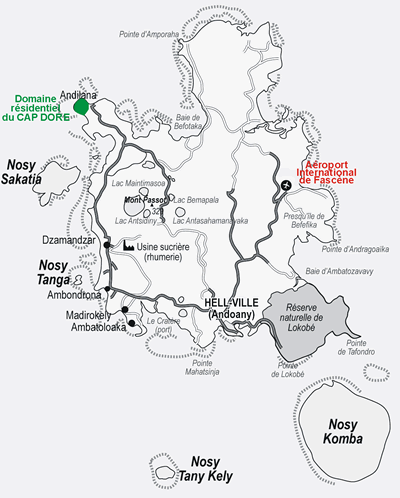
Nosy Be is a 321 km² island located on the northwest coast of Madagascar. A paradise island, rich in flora and fauna, it's a promised land for divers with its vast coral reef forest. It's the showcase of tourism in Madagascar, a dream destination boasting numerous white sand beaches.
Surrounded by stunning small islands, Nosy Be is a land of dreams and unparalleled adventure. Its economy is increasingly focused on the tourism sector, which is growing rapidly thanks in part to the opening of its airspace to regional and international travel. Air Madagascar, Corsairfly, and Air Austral are airlines that offer direct flights to Nosy Be from France and Europe.


Besides its beautiful coral sand beaches, Nosy-Be offers many attractive sites, including a hilly landscape and a very rugged coastline bordered by abundant tropical vegetation.
and small crater lakes.
Its favorable geographical position (to the west of Grande Terre which protects it from the trade winds) allows for calm navigation throughout the entire area all year round.
Andilana
Located in the northwest of Nosy Be, Andilana Bay is a haven of tranquil beauty that contrasts sharply with the bustle of the island's west coast. The unspoiled nature and neighboring villages lend an authentic character to this region. It's no surprise that several residential developments have sprung up here.
The site for the Cap Doré project is located on the western slope of Andilana Bay. Due to its topography, the Cap Doré site offers diverse viewpoints overlooking the entire island, the mainland (Madagascar), the Mistsoa and Radama archipelagos, and the deep blue of the ocean.


A bit of history
If Nosy Be has such a rich history, it is probably due to its particular geography. Located at one end of the monsoon current, a true maritime route to India and Asia, the configuration of Ampasindava Bay makes it one of the safest anchorages in the Indian Ocean, sheltered from the trade winds and cyclones.
The Nosy Be region was therefore naturally predisposed to be a zone of contact between civilizations, religions, cultures, trade flows, and trafficking of all kinds, including slavery. Only a strategic error by General Gallieni in 1896 prevented Ambavatoby Bay from becoming the major port of northern Madagascar, as the construction of Diego-Suarez had already begun at the time of the annexation of the rest of Madagascar.
Thus, Arab sailors were the first foreigners to appear in the region, around the year 800. They established the fortified city of Mahilaka around 900, the Mamoko trading post around 1400, the village of Ambanoro around 1500, and the trading post of Ambatoloaka, in partnership with the Portuguese. From 1700 onwards, they were supplanted by Indians at Ambanoro.
In 1830, Nosy Be had 200 inhabitants, the Antakarana people. They were joined in 1837 by Tsiomeko, Queen of the Sakalava, and her 12,000 warriors, who had been pursued by the Merina on the mainland after the repeated defeats of her great-uncle, King Andriantsoly, at Mahajanga in 1824 and at Anorotsangana in 1831. Sent by Admiral de Hell, Governor of Bourbon (Réunion), Captain Passot arrived in Nosy Be in 1839, searching for a suitable port for French warships. A protectorate treaty was signed on July 14, 1840. For the next 56 years, Ampasindava Bay served as the border between France and Madagascar. Queen Binao supported the French during their wars of 1884 and 1895 against the Merina.
In late 1904 or early 1905, a squadron of the Imperial Russian Fleet, en route from Saint Petersburg to Port Arthur, stopped in Ambavatoby Bay before being destroyed by the Japanese at Tsushima on May 27, 1905. While gold jewelry was reserved for members of the royal family, silver bracelets were very common. These were melted down from old silver 5-franc coins and imbued with beneficial powers during a ritual ceremony. Some of the silver coins given to the king as a token of gratitude were used to make chains 3 to 4 meters long, which were used to close the coffins of princes.
In the past, the Sakalava used to place their precious objects in a carved stone urn. This was then buried near their hut, to protect the valuables from neighboring raiders or pirates, so great was the insecurity of that time.
Manual skill plays a central role in Nosy Be's crafts. Carpenters build canoes based solely on their memory and experience, as do tablecloth embroiderers. The transformation of wood and coconuts yields astonishing finished products.
Every year for the past 16 years, Nosy Be has lived to the frenetic rhythm of the Donia Festival. After the traditional opening carnival, Malagasy artists, as well as those from across the Indian Ocean, take to the stage. Salegy and sega music electrify the crowd throughout the night.
As in the rest of Madagascar, the foundation of Sakalava culture is ancestor worship. The Mpanjaka (ruling princes) hold a prominent place in this cult, since once deceased and buried in a royal tomb, they continue to influence the world of the living by being consulted during ritual ceremonies.